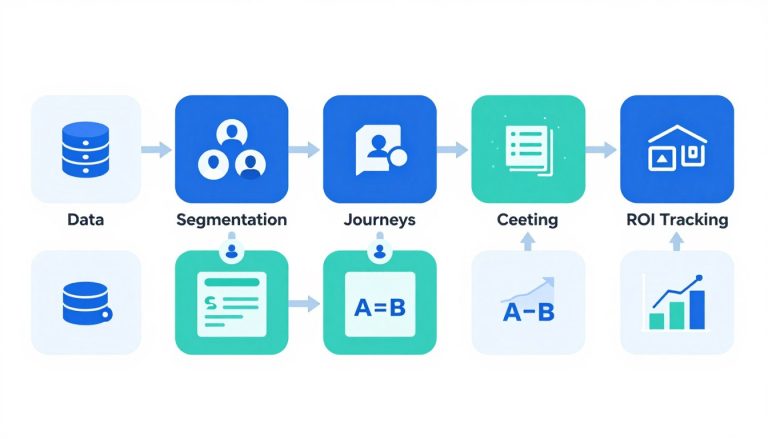
How to Select the Right AI Tools for Your Business

Starting Your AI Journey with a Clear Purpose
The artificial intelligence market is crowded. With countless tools launching each month, business owners and educators often face a kind of decision paralysis. It’s easy to get distracted by impressive features or industry buzz. But the most effective approach isn’t about finding the most advanced tool; it’s about finding the one that solves a specific, well-defined problem within your organisation.
Think of it less like shopping for new technology and more like hiring a specialist for a particular job. You wouldn’t hire a master carpenter to fix a leaky faucet. Similarly, the goal is to match the right AI capability to the right business challenge. This article provides a clear framework to help you move past the hype and make a confident decision that delivers a measurable return on your investment.
Defining Your Business Needs and Goals
Before you even look at a single AI tool, the first step is a candid internal audit. We all have that nagging feeling that some processes could be smoother. The key is to turn that feeling into a concrete plan. This process helps you understand exactly what you need an AI solution to accomplish.
Follow these steps to create a clear roadmap:
- Identify Specific Pain Points. Look for the bottlenecks in your daily operations. Where does work slow down? What repetitive tasks consume your team’s valuable time? This could be the hours spent on manual student enrollment data entry, the high volume of similar customer support queries, or the inconsistent lead qualification that clogs your sales funnel. Write them down.
- Set Measurable Goals. A vague goal like “improve efficiency” is impossible to measure. Instead, aim for a specific outcome, such as “reduce customer service response time by 30%” or “increase qualified leads by 15% within one quarter.” This transforms AI from a vague concept into a tool for achieving tangible business AI solutions.
- Prioritise Your Needs. Not all problems are created equal. Map your identified pain points on a simple impact vs. effort matrix. Which issues have the most significant negative impact on your business but seem relatively straightforward to fix? Start there. Securing an early win with a high-impact, low-effort solution builds momentum and demonstrates value for future AI adoption. Once you have a priority, you can explore various AI business tools to see what’s possible.
Key Criteria for Evaluating AI Solutions

With your prioritised needs in hand, you can begin the process of evaluating AI software. A methodical approach prevents you from being swayed by flashy demos that don’t address your core problems. The best tool is one that fits your team, your budget, and your existing systems.
Feature Relevance Over Feature Quantity
It’s easy to be impressed by a long list of features, but more isn’t always better. Based on the goals you defined earlier, create a simple “must-have” versus “nice-to-have” checklist. A “must-have” is a feature that directly solves your primary pain point. A “nice-to-have” might add value but isn’t essential for success. This simple exercise keeps your evaluation focused on what truly matters.
Integration with Your Existing Tech Stack
An AI tool that doesn’t communicate with your other systems creates more work, not less. It becomes a digital island, requiring manual data transfer and disrupting workflows. Before committing, verify that the tool integrates smoothly with your current technology. Check for native integrations with common platforms like Salesforce, Shopify, or Canvas LMS. If a native connection isn’t available, ask if there’s a robust API or Zapier support to build custom workflows.
User Experience and Team Adoption
We’ve all seen powerful software gather dust because it was too complicated to use. The most sophisticated AI is useless if your team won’t adopt it. A clean interface and a low learning curve are critical. When did you last ask your team what would make their jobs easier? Involve them in the evaluation. A tool that feels intuitive to the people who will use it every day is far more valuable than one with theoretical power that no one can access.
| Feature Category | ‘Must-Have’ Requirement Example | ‘Nice-to-Have’ Feature Example | Questions to Ask the Vendor |
|---|---|---|---|
| Automation | Automates weekly sales reporting | Predictive sales forecasting | What manual tasks does this fully replace? |
| Integration | Native integration with our CRM (e.g., HubSpot) | Zapier integration for custom workflows | Can you provide a list of all native integrations? |
| Data Security | SOC 2 Type II compliance | Customizable user permission levels | Where is our data stored and how is it encrypted? |
| User Interface | Intuitive dashboard for non-technical users | Mobile application access | Can my team trial the full user interface? |
Note: This checklist is a template. Businesses should customize the ‘Must-Have’ and ‘Nice-to-Have’ columns based on the specific needs identified in their internal audit.
Assessing Scalability and Total Cost of Ownership
The sticker price of an AI tool is only one part of the equation. To make a sound financial decision, especially for AI tools for small businesses, you must consider both its ability to grow with you and its total cost over time.
Scalability means the tool can handle an increased user base, data volume, or workload without a drop in performance or a sudden, massive price hike. Can it support five team members today and fifty next year? What happens when your customer data doubles? A scalable tool grows alongside your business, not despite it.
Beyond the monthly subscription, the Total Cost of Ownership (TCO) includes all associated expenses. Consider these hidden costs:
- Implementation and setup fees
- Costs related to migrating data from old systems
- Time and resources for team training and onboarding
- Ongoing maintenance or premium support contracts
- Charges for additional users or features as you expand
As noted in a 2025 guide from Enate.io on choosing an AI business tool, it’s critical to demand real case studies and consider the total cost of ownership, not just the subscription fee. Calculating your return on investment requires weighing the full TCO against projected efficiency gains or revenue growth.
Using Trials and User Feedback to Validate Your Choice

You’ve narrowed down your options. Now it’s time for the most critical step in how to choose AI tools: validation. A free trial is not just for casual exploration; it’s a structured test to confirm the tool delivers on its promises within your specific environment.
To get the most out of a trial period, follow this plan:
- Enter with a Plan. Don’t just click around. Based on your initial goals, define two or three specific use cases you want to test. For example, “Can this tool automate our student onboarding emails?” or “Does it accurately categorise support tickets?”
- Involve the End-Users. The person who will use the tool daily is your most important critic. Get their hands-on feedback. Does it simplify their workflow or complicate it? Their buy-in is essential for successful adoption.
- Set Success Metrics. Measure the tool’s performance against the goals you set in the beginning. Did it actually reduce the time spent on a task by your target of 20%? Hard data, even from a short trial, is more valuable than any sales pitch.
Alongside your own testing, look for authentic user reviews on platforms like G2 and Capterra—filter for reviews from companies in your industry and of a similar size. Look for recurring themes in both positive and negative comments, paying close attention to mentions of customer support quality. A detailed analysis, like the kind you might find in our in-depth WriterZen review, shows the level of scrutiny needed to make a wise choice. Finally, ask vendors for case studies from US-based businesses to see real-world proof of value.
Matching AI Tools to Your Specific Industry
The best AI solutions are often those designed with a specific industry’s challenges in mind. A generic tool might work, but a specialised one understands your unique vocabulary, workflows, and customer expectations. Here’s how to think about it for different sectors.
AI Tools for Educators and Course Creators
For educators, the most significant opportunity lies in automating administrative burdens to free up time for teaching and student interaction. Look for AI tools for educators that offer automated quiz grading, plagiarism detection, or AI-powered chatbots to handle common student questions about deadlines or resources. For those focused on creating secure and efficient learning environments, it’s worth exploring the best AI chatbot tools for secure student support. These tools can provide instant answers 24/7, improving the student experience while reducing instructor workload.
AI for E-commerce Businesses
In e-commerce, every click matters. The right AI for e-commerce can directly influence your bottom line. Advanced product recommendation engines can increase average order value by showing customers items they are genuinely likely to buy. Dynamic pricing algorithms can adjust prices based on demand, competitor pricing, and inventory levels. Furthermore, AI-driven inventory management helps prevent costly stockouts of popular items. There are many specific AI tools for e-commerce designed to boost sales with automation that can streamline these processes.
AI for Marketing and Content Creation
Marketers are tasked with capturing attention in a noisy world. AI can provide a serious advantage. Tools can help with everything from generating blog post ideas and optimising headlines for SEO to segmenting customer lists for hyper-targeted email campaigns. Predictive analytics can forecast which marketing channels will deliver the highest return on ad spend. For professionals looking to streamline their workflow, a wide range of AI content creation tools can assist with ideation, drafting, and polishing written material.
Making Your Final Decision with Confidence
Choosing the right AI tool is a strategic business decision, not a technical one. By following a structured process, you move from being a passive buyer to an empowered decision-maker. This approach ensures you select a solution that integrates smoothly, is adopted enthusiastically by your team, and delivers clear, measurable results.
To make your final choice with confidence, remember this framework:
- Define your specific need and set measurable goals.
- Evaluate tools based on features, integration, and usability.
- Assess the total cost of ownership and long-term scalability.
- Validate your choice with free trials and authentic user feedback.
- Prioritise solutions tailored to your industry.
This methodical process ensures you select an AI partner that will drive genuine growth and productivity for your business or institution.