Using AI to Secure Your Online Course Content

The Growing Need for Advanced Course Security
The online education market in the United States has grown into a massive industry, reflecting a fundamental shift in how we learn and upskill. With this expansion comes an unwelcome partner: a significant increase in security vulnerabilities. For course creators, these are not abstract technical problems. They represent direct threats to revenue and reputation. Common issues like fraudulent sign-ups and rampant account sharing directly devalue your educational product, turning a premium course into a freely passed-around commodity.
We’ve all become accustomed to simple password protection, but these outdated methods are like a simple latch on a bank vault door. They are insufficient for protecting high-value digital content from modern, sophisticated threats. For programs offering certifications, this weakness is even more damaging. If anyone can share an account to gain a credential, the qualification itself loses all credibility in the eyes of employers and the industry. This erosion of trust is a critical factor, a topic we explore when discussing why some courses fail to gain traction.
This is where AI for online course security comes in. Think of it not as complex code, but as an intelligent gatekeeper. Unlike static security measures that only react after a breach, AI-powered systems proactively anticipate and neutralize threats. They learn patterns, identify anomalies, and act as a vigilant guard for your digital classroom, ensuring that your hard work remains valuable and your students’ achievements remain legitimate.
How AI Reinforces Student Identity Verification

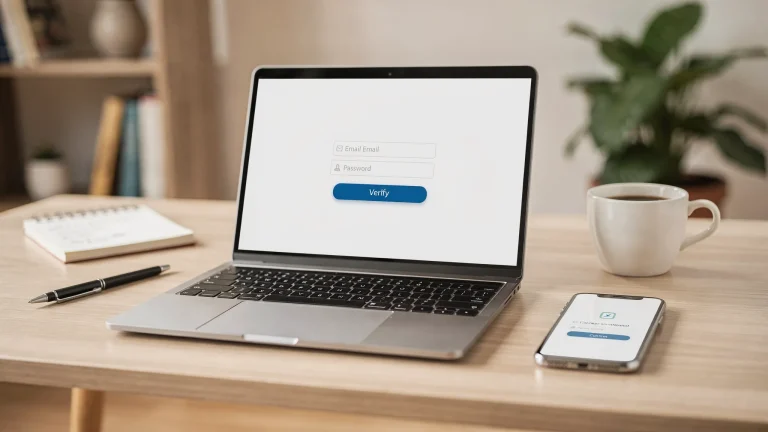
With the need for better security established, the first line of defense is ensuring every student is exactly who they claim to be. The business world has long used a principle called Know Your Customer (KYC) to prevent fraud. That same intelligent approach is now being applied to education through student identity verification AI. These systems create a secure, one-to-one link between a student and their account right from enrollment, making it incredibly difficult for imposters to get through the door.
The process is surprisingly straightforward for the user, even though the technology behind it is advanced. Here’s how it typically works:
- Biometric Verification: The system prompts the student to take a live selfie with their webcam or phone. AI then analyzes this image and compares it to the photograph on a government-issued ID, like a driver’s license, that the student also uploads. It confirms the face belongs to the name on the document.
- Liveness Detection: To defeat someone simply holding up a photo, liveness detection analyzes subtle cues. It might ask the student to blink or turn their head, confirming through micro-expressions and movements that a real, live person is in front of the camera.
- Document Forgery Analysis: AI algorithms scan the uploaded ID for signs of tampering that are invisible to the human eye. This includes checking for inconsistent fonts, altered barcodes, or pixel patterns that suggest digital manipulation.
According to identity verification provider Jumio, these systems use machine learning and computer vision to “assess documents, match biometric data, detect fraud, and evaluate risk, all in real time.” The goal is to create a robust verification process that doesn’t frustrate legitimate students. Modern systems are designed to verify students without friction, making security a seamless part of the onboarding experience rather than a roadblock.
AI Tools for Preventing Cheating During Assessments
Once you have verified your students, the next challenge is maintaining integrity during exams. This is where AI proctoring tools and other technologies for secure online assessments become essential. These systems act as digital supervisors, ensuring a fair and cheat-free testing environment. An AI-powered proctoring system uses a student’s webcam and microphone to monitor for suspicious behavior. It can flag events like a second person entering the room, the student looking at a phone, or opening another browser tab.
While powerful, it is important to choose systems that respect student privacy and are transparent about what is being monitored. Beyond proctoring, another tool is an AI-enhanced lockdown browser. This application prevents students from accessing unauthorized materials by locking down their computer, blocking access to other websites, applications, and files for the duration of the test.
A more advanced method is behavioral biometrics. This technology creates a unique digital signature for each student based on their natural typing rhythm, mouse movement patterns, and navigation habits. If someone else takes over the keyboard mid-exam, the system can detect the change in behavior and flag the session for review. Finally, to combat answer sharing, AI can generate cheat-proof exams by pulling from a large question bank to create a unique test for every single student. These are just a few of the AI tools every course creator needs for safe access to their assessments.
| Method | How It Works | Best For |
|---|---|---|
| AI Proctoring | Monitors webcam/microphone for suspicious behavior during exams. | High-stakes certification exams requiring human presence verification. |
| AI-Enhanced Lockdown Browser | Prevents access to other applications, tabs, or files during a test. | Standardized tests where the primary concern is access to outside information. |
| Behavioral Biometrics | Analyzes typing patterns and mouse movements to verify user identity continuously. | Continuous assessment environments and protecting against account takeovers. |
| AI Question Banks | Generates unique exam versions for each student from a large pool of questions. | Large-scale courses where preventing answer sharing is a priority. |
This table provides a summary of different AI tools for securing assessments, helping course creators choose the right method based on their specific security needs and the nature of their course.
Protecting Your Course Content from Piracy

Beyond verifying students and securing exams, you must also protect digital course content itself. Nothing is more disheartening for a creator than finding their meticulously crafted videos and materials on a pirate website. Fortunately, AI provides several powerful tools to prevent online course piracy and safeguard your intellectual property. These methods create multiple layers of defense, making it harder for thieves to profit from your work.
Here are some of the most effective AI-driven strategies:
- Advanced Plagiarism Detection: We’ve moved far beyond simple text matching. Modern AI tools can identify heavily paraphrased content, recognize translated text, and even detect similarities in code or structure. This ensures the work students submit is truly their own.
- Dynamic Digital Watermarking: This is a potent deterrent. Invisible, unique identifiers are embedded into your course videos and PDFs. Each file downloaded is tied to a specific user account. If that content is leaked online, the watermark can be extracted to trace it directly back to the source of the leak.
- Automated Takedown Services: Instead of manually searching for pirated content, you can deploy AI crawlers that constantly scan the internet. These bots search torrent sites, forums, and file-sharing platforms for your material. When a copy is found, the service can automatically initiate a DMCA takedown request on your behalf.
These security principles are not just for courses; they apply broadly to protecting any premium digital asset, which is why they are often included among the most popular AI tools for membership security. However, it’s important to maintain a balanced perspective. These tools are not infallible, and transparency is key. You should always inform your students about the security measures in place and how their activity is monitored. This builds trust and shows you are using these tools responsibly.
Implementing an AI Security Strategy for Your Course
Knowing about these tools is one thing; implementing them effectively is another. A successful AI security strategy is not about adopting every tool at once. It’s about making smart, prioritized choices that fit your specific needs. Start by conducting a simple risk assessment. Is your primary vulnerability exam cheating in a certification program, or is it widespread content piracy of your video lectures? Answering this question helps you focus your investment where it matters most.
Adopt a layered security approach. Think of it like a home security system: you have locks on the doors (identity verification), alarms inside (AI proctoring), and cameras watching the perimeter (piracy crawlers). Combining these elements creates a much more robust defense than any single tool could provide on its own. At the same time, you must balance security with the user experience. An overly intrusive system can frustrate legitimate students and create more problems than it solves. Choose tools that are effective yet seamless.
Looking ahead, these technologies will only become more integrated into our digital lives. The generative AI in the cybersecurity market is expected to grow almost tenfold between 2024 and 2034, as noted in research from Syracuse University. This indicates that AI security tools will become more sophisticated and accessible. To build your strategy, we encourage you to explore the comprehensive reviews and guides available on AI Tool Shed to find the right solutions for your course.