Chatbot with AI: Verify Students Without Friction

Teaching online should feel exciting, not like a never-ending battle against password sharing and fake accounts. Yet a 2024 survey by EduCause found that 29 percent of course creators lose revenue every month because log-ins are passed around.¹ Traditional CAPTCHAs and manual ID checks slow everyone down, and students abandon sign-up pages at alarming rates.
A smarter approach is emerging: a chatbot with AI that verifies students conversationally, at the exact moment they enrol or attempt to access premium modules. In this guide you will learn how frictionless verification works, which AI tools already support it, and how to integrate the workflow into your learning management system without hiring a team of engineers.
Why conversational verification beats forms and CAPTCHAs
Old-school verification relies on clunky steps: fill a form, upload an ID photo, wait for manual review or solve ever-harder CAPTCHAs. Completion rates can drop below 70 percent on mobile, according to Baymard Institute usability studies.² A conversational AI chatbot flips the script by keeping students inside a friendly chat window they already know from WhatsApp or Facebook Messenger.
Key advantages over legacy methods:
- Real-time identity proofing, usually under 30 seconds, minimises churn at checkout.
- Adaptive questioning tailors prompts to the learner’s context (device, previous attempts, course tier).
- The bot can explain why data is needed, alleviating privacy anxiety and boosting trust.
- NLP makes the experience accessible to non-native speakers and students with disabilities, unlike distorted image CAPTCHAs.
How an AI chatbot verifies a student in 5 steps
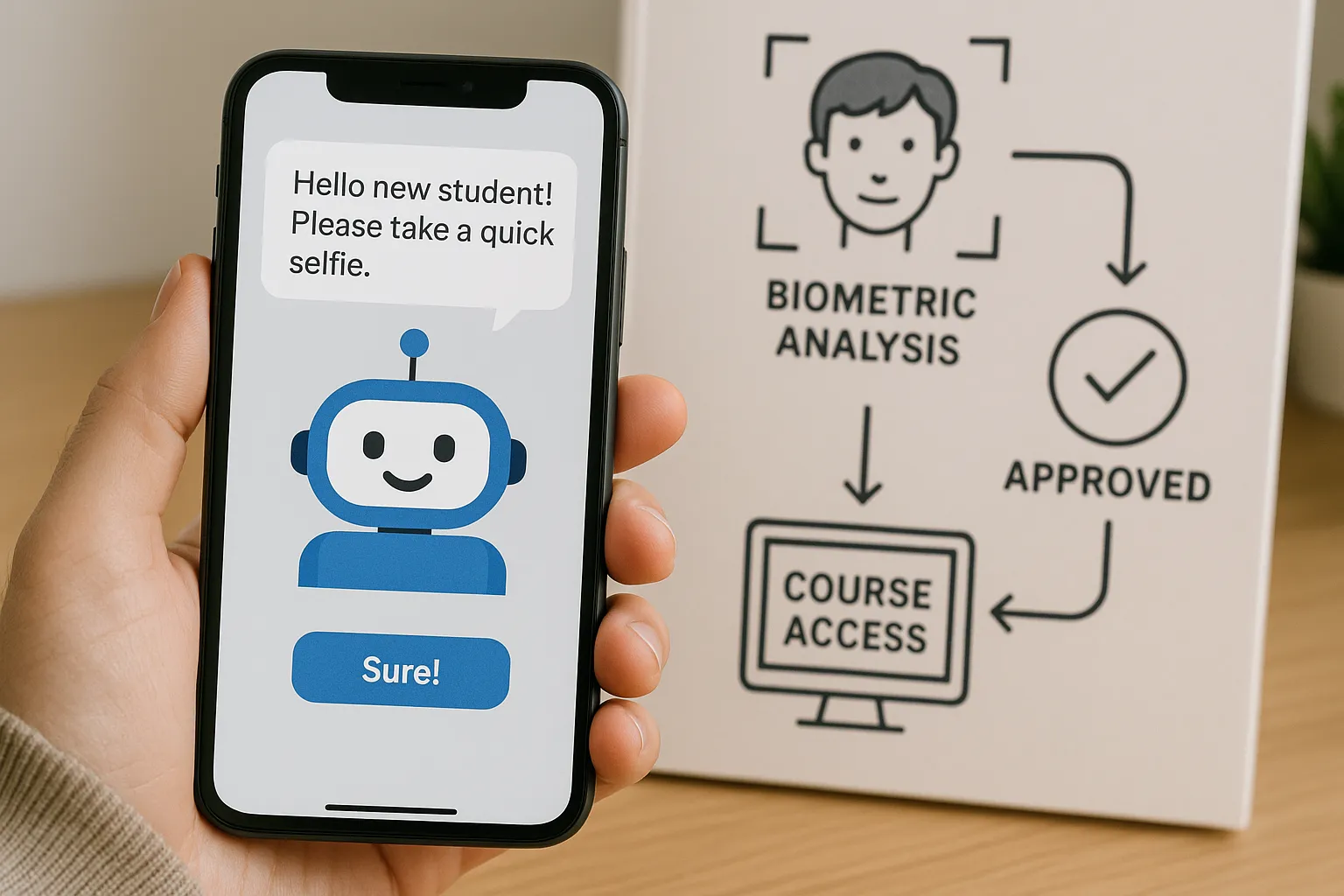
- Trigger event: the learner clicks “Start course” or tries to unlock a certificate. Your LMS sends a webhook to the chatbot service.
- User consent: the bot greets the learner by name and briefly states what data will be collected and why.
- Data capture: depending on the risk score, the bot requests one or more of the following:
- A quick selfie for liveness detection.
- An image of a government ID or a student card.
- Answers to dynamic knowledge-based questions (for instance, “Which town did you register as your billing address?”).
- AI analysis: computer-vision models compare the selfie with the ID photo, OCR extracts text, and a fraud-detection engine checks global watch lists. Large language models (LLMs) analyse free-text answers for coherence.
- Decision & onboarding: if verification passes, the chatbot issues a token to your LMS, unlocking the lesson instantly. If it fails, the learner receives tailored guidance or an escalation to human review.
Tool roundup: AI chatbots that support student verification
Below is a comparison of well-established identity platforms that expose APIs or pre-built chat widgets. Pricing is indicative; always confirm the latest tiers on each vendor’s site.
| Platform | Verification methods | Chatbot integration | Starting price | Ideal for |
|---|---|---|---|---|
| Persona | ID document, selfie, database checks | Pre-built React widget embeddable in any chat UI, or use API with Dialogflow / Rasa | Pay-as-you-go from 1 USD per verification | Cohorts over 1 000 students needing global coverage |
| Stripe Identity | Government ID, selfie, risk scoring | Works with Stripe’s own Checkout chat-style flow or via API in Intercom bots | 1.50 USD per completed verification | Course creators already using Stripe payments |
| Passbase | ID + biometric, video liveness | Web SDK embeds inside WhatsApp or Messenger bots, optional Passbase Chat UI | 0.80 USD per verification on scale tier | Budget-sensitive micro-courses |
| Veriff | 11 000+ ID types, age verification | Veriff conversation SDK integrates with custom chatbots; ready-made UI kit | Custom quote | Institutions needing K-12 or 18+ compliance |
| Forethought Solve | Semantic intent + ID escalation | AI agent handles support and identity queries in one chat window | From 140 USD per agent / month | Academies with heavy support tickets |
None of these tools force you to abandon your favourite chatbot builder. Platforms like ManyChat, Landbot, or custom GPT-4o agents can call the verification API mid-conversation and decide the next branch instantly.
Internal automations without code
If you prefer a no-code approach, orchestration platforms such as Make or Zapier can glue everything together. We recently compared their strengths in detail in Make vs Zapier: Advanced Automation Platforms Compared. In short, both tools let you:
- Capture a webhook from your chatbot when the learner reaches the verification step.
- Send the captured images or data to Persona or Stripe Identity.
- Receive the response and update a row in Airtable or your LMS via API.
- Notify the student in real time using the same chat thread.
Step-by-step implementation for course creators
- Map the risk points: not every lesson needs ID verification. High-value modules, certification tests and community Slack invites are typical choke points.
- Choose an identity provider: evaluate coverage (supported countries, ID types), GDPR compliance and unit cost. If you already process payments with Stripe, starting with Stripe Identity simplifies onboarding.
- Design a concise flow:
- Greet and inform within 160 characters.
- Ask for the selfie first; it reassures the learner that completion is near.
- Accept multiple image retakes without forcing the learner to restart.
- Integrate via API or no-code router: in Dialogflow CX or Voiceflow, create a webhook fulfilment step that calls the provider’s endpoint and yields an approve/decline event.
- Store only tokens, not raw images: most providers return a verification-passed token. Save that to your LMS and discard biometric data to stay GDPR-friendly.
- User testing: enlist five beta testers on different devices (laptop, iOS, low-end Android, poor lighting). Measure completion time and emotional sentiment.
- Launch and monitor: track real-time KPIs in a dashboard. After the first week, tweak thresholds and fallback instructions.
Metrics that prove it is working
| KPI | Target benchmark | Why it matters |
|---|---|---|
| Average verification time | < 40 seconds | Anything longer risks abandonment |
| Completion rate (start to pass) | > 92 percent | Indicates friction level |
| Fraudulent account reduction | 70 percent within 30 days | Direct revenue protection |
| Support tickets about log-in issues | ‑50 percent | Shows clarity of the chatbot flow |
According to Stripe’s 2025 user study, customers who embed Identity in a conversational flow see a 34 percent higher completion rate than when the same step is presented as a standalone form.³
Privacy, ethics and accessibility checklist
- GDPR and UK DPA 2018: activate data residency options where possible and set auto-deletion to 24 hours unless legally required.
- Under-18 learners: if your course targets minors, ensure the provider supports age gates and parental consent flows.
- WCAG 2.2 compliance: provide voice narration and keyboard navigation in your chatbot. AI models like ElevenLabs can generate the voice-over automatically; see our roundup of Top 10 AI Voice and TTS Tools for Content Creators.
- Bias mitigation: audit face-matching accuracy across skin tones. Persona and Veriff publish quarterly fairness reports; verify that error rates stay within acceptable margins.
Future trends to watch
- LLM-powered behavioural analytics: GPT-4-class models can detect copy-paste patterns or unusually formal language that hints at contract cheating.
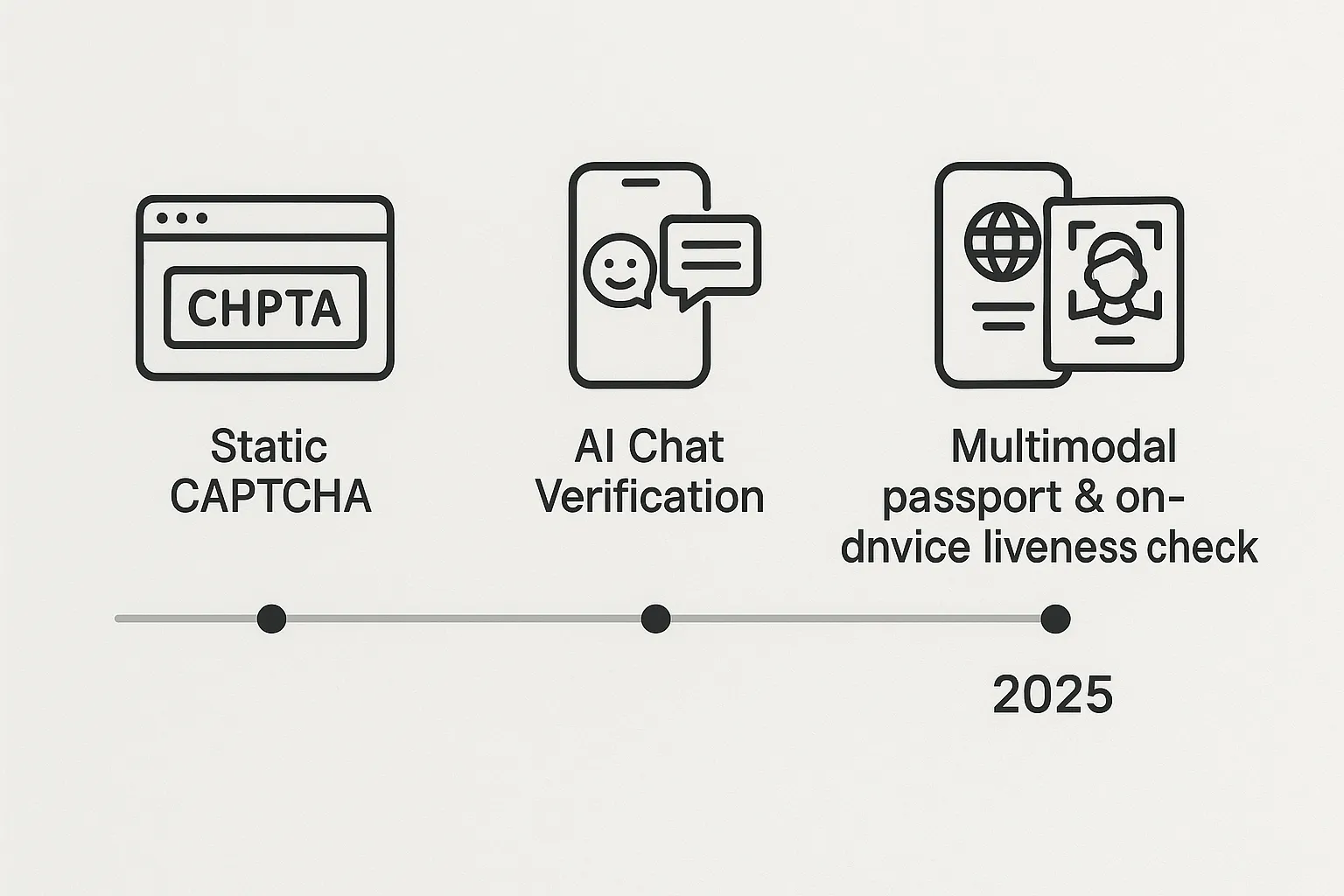
- On-device liveness detection: Apple’s Private Cloud Compute, unveiled at WWDC 2025, allows biometric checks without sending raw images to servers.
- Multimodal passports: W3C-compliant verifiable credentials may soon let learners store a reusable “education passport” in their digital wallet, which a chatbot can request with one tap.
Conclusion: verification without the headache
A chatbot with AI can turn identity checks from a conversion killer into a seamless part of your brand experience. By embedding document scanning, biometric matching and adaptive NLP inside the conversation, you protect revenue, comply with regulations and keep genuine learners happy.
Start small: pick one high-value module, integrate an identity API through your existing chatbot tool, and measure the impact for a fortnight. Most creators recover the implementation cost in under a month through reduced account sharing alone.
For more inspiration on choosing the right automation stack and AI utilities, explore our recent review of the Best Free AI Tools for Small Businesses in 2025. When you are ready to supercharge your course operations with ethical, student-friendly AI, a frictionless verification chatbot is one of the quickest wins you can deploy this year.
¹ EduCause Horizon Report 2024, Digital Learning Edition.
² Baymard Institute, Mobile Checkout UX Benchmark 2024.
³ Stripe Identity Impact Study, Q1 2025.