Best AI Tools to Stop Spam Signups

Spam signups are more than an irritation for course creators. They skew your student analytics, eat into email-marketing quotas, and can even open the door to fraud and phishing attacks. The good news is that a new generation of AI-driven verification tools can filter out automated bots and low-quality signups before they ever reach your learning management system (LMS).
In this guide we review the best AI tools to stop spam signups in 2025, compare their strengths, and show you how to pick the right stack for your online course business.
Why Course Creators Need Smarter Bot Defences
- Inflated user counts make it hard to track funnel performance or true completion rates.
- Bulk fake accounts can nab discount codes or free trials, reducing revenue.
- Bad actors may test stolen cards through your payment gateway, risking chargebacks.
- Deliverability suffers when you email thousands of throw-away addresses, harming future marketing campaigns.
- According to Imperva’s 2024 Bad Bot Report, 32 percent of automated traffic now targets account creation flows, up from 26 percent the previous year.
Traditional text-based CAPTCHAs stop only the laziest scripts. Modern attackers employ headless browsers and AI to solve challenges in milliseconds. Fighting AI with AI is now essential.
How AI-Powered Signup Protection Works
- Behavioural analysis: Machine-learning models observe cursor speed, keypress timing, and paste events to separate humans from scripts.
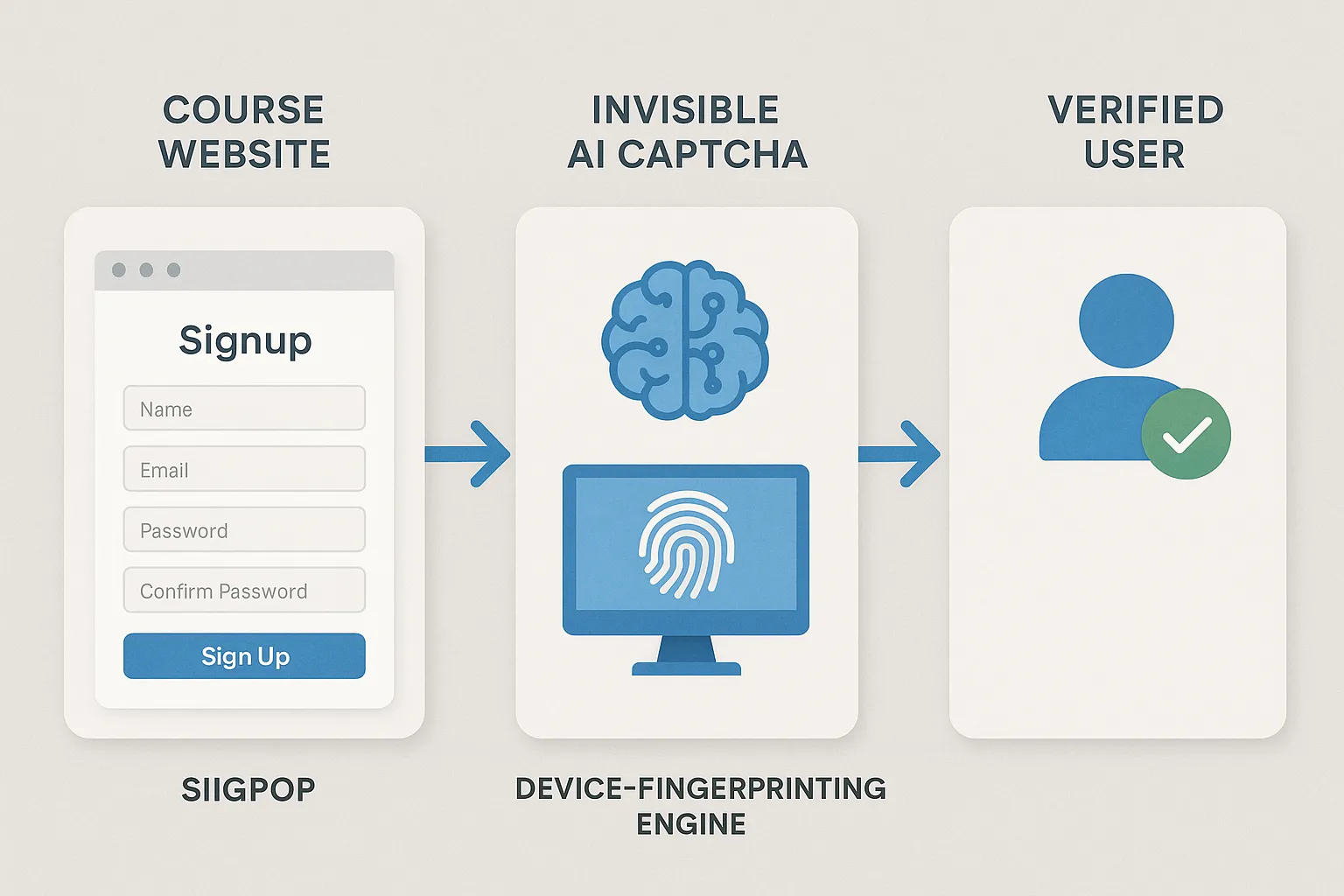
- Device fingerprinting: Unique hashes built from IP, GPU, and browser entropy identify repeat offenders even behind VPNs.
- Reputation graphing: Aggregated intel from millions of sites flags IPs and devices previously marked as malicious.
- Real-time risk scoring: Instead of a binary pass/fail, each signup receives a risk score so you can decide whether to block, challenge, or allow with limits.
Layering these signals trims friction for legitimate students while quietly blocking bots in the background.
Top AI Tools to Stop Spam Signups in 2025
Below are the platforms course creators praise for high catch rates, quick implementation, and reasonable pricing. Every tool listed offers machine-learning-based detection rather than simple heuristic rules.
| Tool | Best for | Key AI Features | Pricing (Nov 2025) | Free tier? |
|---|---|---|---|---|
| Google reCAPTCHA Enterprise | All-round defence with Google data graph | Adaptive risk score, behavioural ML, account-takeover signals | From $0.10 per 1000 calls; first 1 M monthly at $0. | Yes (up to 1 M calls) |
| hCaptcha Enterprise | Privacy-focused sites needing GDPR clarity | Challenge difficulty tuned by ML, device fingerprint, risk API | Quote-based; Pro plan £9.99 monthly | Yes (Community plan) |
| Arkose Labs | High-value courses needing SLA & managed service | Real-time risk engine, 3D puzzle challenges, managed SOC | Custom contract | No |
| DataDome | Real-time edge protection for global audiences | 3-stage AI engine analysing 400+ signals per request | Starts at $299 mo | 30-day trial |
| Friendly Captcha | Ultra-low friction for mobile learners | Proof-of-Work puzzle solved by device, AI anomaly scoring | €5/1000 requests after 30K free | Yes (30K / mo) |
| Fingerprint Pro BotD | Identifying repeat fraud rings across LMSs | ML fingerprint clustering, open-source JS agent | From $0.002 / request; 100K free mo | Yes |
| SEON | Combating promo abuse & payment fraud | AI risk engine, velocity detection, social footprint enrichment | From $299 mo | 14-day trial |
1. Google reCAPTCHA Enterprise
Why we like it: Leveraging Google’s visibility into web traffic, reCAPTCHA Enterprise trains models on the newest automated threats. The adaptive score (0-1) lets you silently accept trusted signups, prompt a challenge, or block. Integration is a single JavaScript snippet plus one server-side call.
Caveat: Dashboard reporting is limited; you may need BigQuery exports for deep analysis.
2. hCaptcha Enterprise
hCaptcha solves two common complaints about Google’s offering: data privacy and visual accessibility. Their AI engine routes most humans through an invisible flow, only issuing a picture challenge when confidence drops. Revenue-sharing for solved tasks offsets costs on high-volume sites.
3. Arkose Labs
If your course catalogue attracts fraudsters attempting credential-stuffing or credit-card testing, Arkose merits a look. Their managed service combines risk scoring with interactive 3D puzzles. A 2024 Forrester TEI study found clients cut fake account creation by 96 percent and achieved 141 percent ROI in under six months.
4. DataDome
DataDome sits at the CDN edge, blocking malicious requests before they hit your origin. Its three-stage engine (signature, behaviour, and global threat intel) updates every second. For course creators running WooCommerce or Shopify storefronts alongside the LMS, this extra layer shields the entire stack.
5. Friendly Captcha
Differentiator: No pictures, no audio. The user’s device performs a short cryptographic Proof-of-Work while the form submits. Machine-learning checks on backend data further validate the signup. The result is WCAG-AA compliance with almost zero cognitive load.
6. Fingerprint Pro BotD
BotD is the anti-bot module of FingerprintJS. It assigns every visitor a stable, privacy-respecting identifier and a bot probability score. Open-source SDKs for React, Next.js, and Vue ease integration with popular course platforms like Teachable and Kajabi.
7. SEON
More than a CAPTCHA, SEON builds a risk profile from email, phone, and IP intelligence in milliseconds. That makes it perfect for stopping coupon abuse and mass free-trial farming. Built-in velocity logic spots the same user spinning up throw-away Gmail aliases.
Choosing the Right Tool for Your Course Business
Consider the criteria below before committing:
- LMS compatibility: Does the vendor offer a plug-in for Thinkific, LearnDash, or MemberPress?
- Student geography: Some CAPTCHAs are blocked in China; edge solutions minimise latency.
- Accessibility compliance: Visual challenges frustrate users with low vision. Aim for inclusive options.
- Data residency: If you teach EU learners, ensure GDPR-ready processing and SCCs.
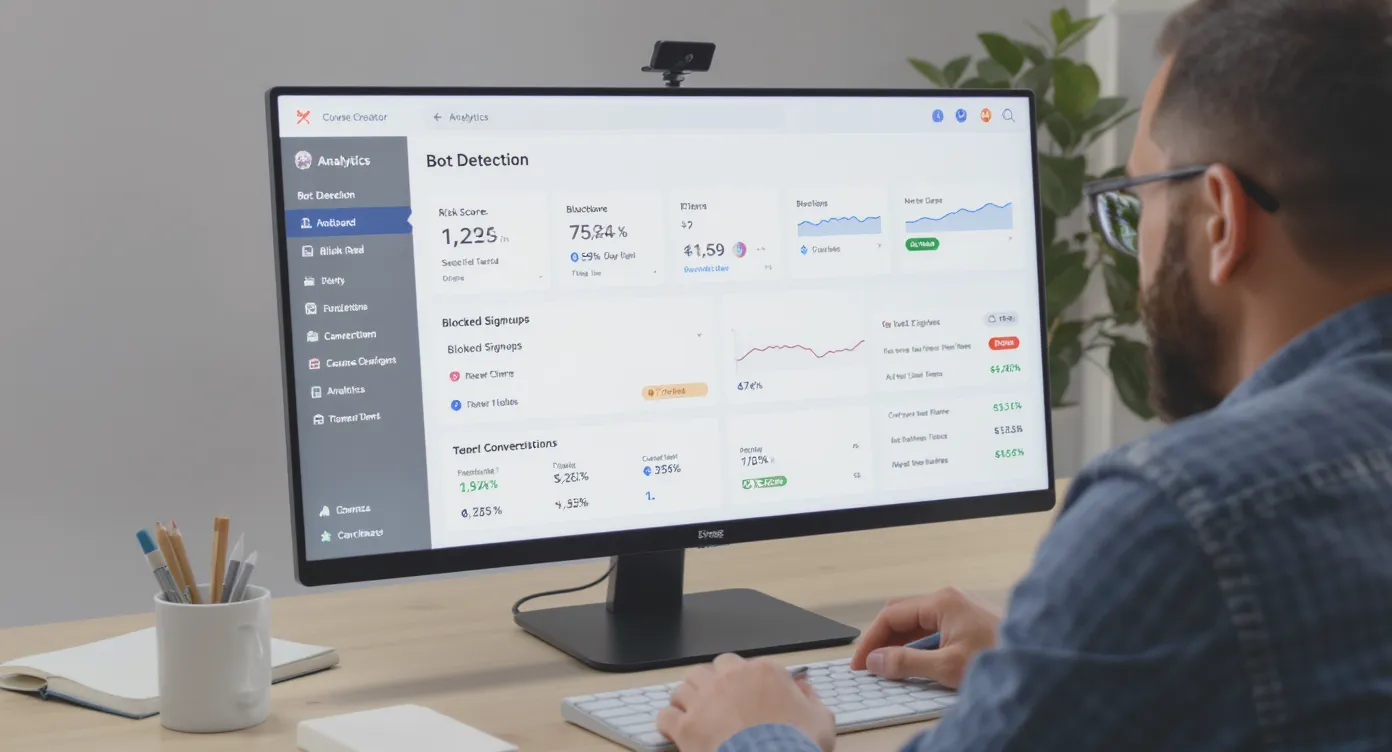
- Reporting depth: Look for dashboards that break down human versus bot ratios so you can fine-tune marketing attribution.
- Cost at scale: Spreadsheet forecast the monthly request volume around launches or evergreen funnels. A per-call fee that looks tiny can snowball.
Pro tip: Pair a low-friction invisible CAPTCHA on the frontend with server-side device fingerprinting. This dual-layer approach catches more bots without raising the barrier for genuine students.
Implementation Checklist
- Map the exact points where users can create an account (checkout, lead magnet, third-party pop-ups).
- Deploy your chosen CAPTCHA in test mode to collect baseline risk scores for seven days.
- Set threshold rules: e.g., block scores <0.3, challenge 0.3-0.7, allow >0.7.
- Enable server-side verification to avoid token reuse.
- Monitor false positives. Add allow-listing for internal QA or support staff IPs.
- Track KPIs: signup-to-purchase conversion, email bounce rate, chargeback rate.
Frequently Asked Questions
Is an AI CAPTCHA enough on its own? A smart CAPTCHA blocks basic scripts, but pairing it with device fingerprinting or email enrichment catches sophisticated fraud rings.
Will extra verification hurt my conversion rate? Invisible or adaptive CAPTCHAs keep friction minimal. Google reports an average completion time of under two seconds for reCAPTCHA v3 challenges.
Can bots solve image CAPTCHAs now? Yes. Services using generative AI can break simple image challenges at up to 95 percent accuracy. Behavioural AI plus server-side scoring remains harder to bypass.
Which tool is the most GDPR-friendly? hCaptcha and Friendly Captcha both offer EU data centres and clear DPIAs. Always sign a DPA with any vendor handling user identifiers.
How do I test effectiveness? Run an A/B split: half your traffic hits the new protection, the other half sees your existing flow. Compare blocked signup ratios and downstream purchase rates after two weeks.
Stop Bots Before They Enter Your Classroom
Protecting your course community should not consume your creative energy. By adding an AI-powered verification layer, you reclaim accurate metrics, save on email costs, and keep fraudsters at bay.
Ready to see bot defence in action? Our platform at Bot Verification offers a lightweight verification step that integrates with any course site in minutes. Explore the docs or request a live demo today.